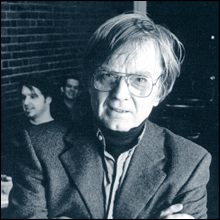
Robert Coover was born in Charles City (Iowa) on February 4, 1932.
professor of literature for a long time to Brown University, made his debut in the world of writing with the novel The Origin of Brunisti in 1966 and his most famous work is The Public Burning (1977).
E 'one of the greatest exponents of postmodern literature, which reflects the tendency metaliterature and reinventions of cultural and literary stereotypes.
interested in the relationship between literature and technology, is one of the founders of the Electronic Literature Organization
, founded with the aim of promoting electronic literature. His latest novel is
NOIR (2010).
An accident led me to do some research as part of my project on Rewriting the body in the postmodern fairy tale at the Ca 'Foscari of Venice in the period in which there took place a series of meetings with international authors.
Grazie alla gentile intercessione della professoressa Rosella Mamoli Zorzi ho avuto la possibilità di avvicinare Robert Coover, uno dei maggiori esponenti del movimento postmoderno e autore di varie riscritture di fiabe, tra cui la raccolta di racconti Pricksongs and Descants e il romanzo Briar Rose .
Coover ha cortesemente accettato di rispondere ad alcune mie domande proprio sul suo rapporto con la riscrittura di trame ben note, in particolare di fiabe; alcune risposte che sono emerse sono state per me sorprendenti, perché hanno messo in dubbio alcuni elementi dati per certi da molti scritti critici.
1)In che modo una storia riscritta può essere originale e comunicare new meanings?
All stories are re-written stories, some are just more aware of the other, is a practice that dates back to the beginning of human storytelling. The oldest example of narrative we have, the Gilgamesh epic , was built with fragments of stories written in the previous two millennia, which in turn were taken after the invention of writing, from a long traditional oral. The writers of the Bible have used similar materials of popular rituals in their rewrites, as did Homer (or Homer), Ovid, etc. ... The Don Quijote is one of the most original stories that are ever written, but it is also composed of short stories partly rewritten, in this case taken up by pastoral novels and chivalrous, which in turn are rewrites of songs of the Troubadours, who have their own versions of old folk and popular storytelling. The art of fiction is a conversation without end through the millennia, which uses a relatively small reservoir of characters and themes that cross historical events, social and intellectual in a flux.
2) Why did you choose to rewrite the most famous fairy tales?
in the unfolding of human speech across continents and centuries, to whom the art of narration and is a significant part of training, the communication between writer and reader is facilitated by familiarity with stories and themes are widely shared. So the prevalence of the themes of love and death was experienced by all. But also because often the stories chosen have left some residue in human thought, however, let you in mine, and this is what needs to be analyzed.
3) What role have your opinion, concepts such as mutilation and body metamorphosis in fairy tales?
These are two very broad themes, perhaps more suited to psychological or sociological essays and not particularly relevant for my personal use of fairy tales. Both definitely have to do with fears of decay, death, death in life (as in the great work of Ovid), the destruction order, the anxieties of the border. The metamorphosis, in contrast to the mutilation, is a kind of magic, an impossible gap to cross, as the chasm between the conscious and unconscious, for example. It is a kind of actualization of a metaphor, an imaginative leap.
4) What is the function of the female body in your Briar Rose? We can see it as an open text that awaits interpretation?
Well, we have a lady of a hundred years forced to become a sort of symbol of contemplation, I believe, but the body as text is now now such a cliché that I would hope that in this case there was a lot more. An equally interesting question might be: what is the function of the female mind? The story begins with a sleeping princess, never awakened, and a prince never escaped the bramble of thorns, each of them create their future in their own fantasies. The opening paragraphs remained static for several years, waiting for some new element that could send the story forward, and this new element was the old fairy tale that one day came in and took control. So, if we were to read the body as a text, perhaps we could start with the fairy, "hideously ugly and vaguely threatening", with its teeth ferro, la sua moltitudine di seni e il suo disperato desiderio di conoscere il “desiderio”. Lei stessa, incidentalmente, riassume alcune “funzioni” di Rose.
5)Quale fiabe offre maggiori possibilità di sovversione creativa?
Quelle che hanno a che fare con i temi universali. Le relazioni tra giustizia e libertà, per esempio, tra il potere e l'impotenza, tra uomini e donne, tra vita e morte, tra speranza e paura.
6)Quale tipo di rapporto tra uomini e donne emerge dalle tue opere che riscrivono le fiabe?
Dipende dalle fiabe scelte. Il rapporto tra una principessa che giace in stato di coma su di un bed and a prince trapped in the thorns, unable to meet, is very different from a Bella who lives a private life with the Beast (see the example of the old granny in my Little Red Riding Hood in Pricksongs & descants ) or a ' Alice in menopause who must endure the taunts of a King of Hearts in a demented Wonderland. There are no answers only with regard to human relationships. That's what makes it endlessly fascinating relationship with them.
7) What is your favorite hero or heroine of the fairy tales?
do not have a favorite. They are all interesting. The best are probably those whose lives or environment are affected by the paradox, ambivalence, from the strangeness, of unfulfilled desires and ambitions, uncertainty, complexity, those with the potential for insight and comedy.
8) In your opinion, what is the power of the story today?
The tale is a way of telling stories among many others, although it is one of the most powerful. In its modern incarnation is something we call gender. It is a conservative form, that despite its content, celebrates and perpetuates the status quo. As a result, my relationship with the fairy tale is often compared.
9) What do you think of the traditional concept of fairy tale and Disney?
The original stories were often told from the point of view of the wretched and downtrodden, for whom violence and injustice were a regular feature, and for which the revenge, when it appeared, was sweet and cruel. The myth of America in the mid-twentieth century focused mainly on the happiness, the innate goodness national overcome the obstacles with courage and sacrifice, the warmth of families and traditional communities, etc ..., and Disney has adapted the old stories to the current ideologies . So the seven dwarfs are not bizarre, but they are a sweet and lovely part of an extended family of happy ending. The princesses are all young and beautiful and toads do not vomit or defecate gold.
10) There is a rewrite of a fairy tale or a story well known that you have not already done so, but you write?
The list is endless. All stepmothers of the collection of the Brothers Grimm, Aesop forest with more than a hundred of his fables. I have already addressed many biblical characters, the stories of The Thousand and One Nights , other characters of fairy tales / folktales / stories for children as Hansel & Gretel , Rip van Winkle , Puff the Magic Dragon , Snow White, Pinocchio , Humpty Dumpty , Punch & Judy , Bluebeard, ecc... Senza menzionare poi le fiabe religiose e nazionali. Attualmente sto lavorando con altri mondi immaginativi, ma non dubito di ritornare di tanto in tanto a questi racconti tradizionali.
E tutto può essere rivisitato nuovamente. The Door: A Prologue of Sorts è molto diversa da Grandmother's Nose , sebbene entrambe partano dalla stessa fiaba.


0 comments:
Post a Comment