PAINTING AS MEDITATION: THE ART OF VISIONARY Philip Rubinov Jacobson 
Philip Rubinov - JACOBSON was born in Rochester, New York. He holds a degree in painting, print art and sculpture, as well as in psychology, philosophy, comparative religion, has exhibited around the world. In 1995 he founded and directed the School of Continuing Education at Naropa University in Boulder, Colorado, and here he worked as dean from 1991 to 1997. He currently works as an artist, writer and lecturer, and is with Ken Wilber and Ernst Fuchs has the dream to establish the first Academy International Museum of Visionary Art in America.
1) I have noticed a great eclecticism in your work, every picture looks different. Your style can be considered experimental? Since I was a boy I sought artistic expression through a variety of styles and media. Although I was identified with the Fantastic Realism e l’Arte Visionaria, io non sono solo né l’uno né l’altro. Molto più semplicemente non hanno mai visto quello che può essere chiamato il mio astrattismo, espressionismo, classicismo, esotismo, folcklorismo e il lavoro di pluristilismo. Nonostante la contemporanea enfasi delle gallerie e le pressioni sullo “stile”, sembrava piuttosto limitato ed estremamente noioso fissarsi e identificarsi con un qualsiasi stile, così mi sono sempre rifiutato di limitare me stesso, godendo quindi della mia libertà creativa. C’è questa forte tendenza di semplificare la mente creativa dei pittori, riponendola in un cassetto designato. Perciò dipingo senza questa preoccupazione. É sempre stato innaturale for me to paint in "a" style. Also I have always been suspicious of artists who create works that always seemed the "same", decade after decade, as I have never seen any growth in their work, no experimental research of versatility. It seems to me that these artists have always been in the same room, where only the wallpaper has changed a bit '.
Painting starts where words end up there, and often exceeds them. The tunnels usually require the artists to write a statement of their artistic expression and its significance. This request assumes that the art itself is something gutted, defective and weak in his unique manner of communication and not in good faith only when described in words. The tyranny of the word image is still affecting the psyche of the minds of the twenty-first century, affecting all the Fine Arts
However, in the heart of today's consumer society, the mystery of art is easily injected into the material world from the tribe visionary. The artistic expression of the spirit inevitably filtered by the culture in general. A knowledge refreshing, rejuvenating and redemption must be part of the good work. For me to follow a line of aesthetic commitment could never fulfill the purpose of my research, this is so simple. Art is a serious game. It can also be playful and free, free to explore the meaning of each. Not all pictures have to be masterpieces, can also be fun and bring happiness, knowledge and satisfaction.
2) Besides being a painter and sculptor, you're also a writer, philosopher and teacher. As all these interests help to characterize your art? Do you think all my commitments are fully and inextricably combined, each direction helps to work with each other. What I learn and feel, as a professor and teacher, and what they express themselves artistically, all reflected and undergoes a spiritual base. Come nelle segrete dottrine degli antichi, questo lavoro ha a che fare con i misteri della vita e le perenni domande che sorgono da un tale esercizio. Il lavoro dei veri artisti è preservato tra un piccolo gruppo di menti d’iniziati fin dall’inizio del mondo. Sono come il Grande Arcano del vecchio, queste opere d’arte, attraverso il simbolo, sottili energie estetiche e l’allegoria dell’astrazione, offrono anche chiavi che aprono una casa del tesoro, piena di verità artistiche, filosofiche, scientifiche e religiose. La grande arte è una pratica spirituale che getta via gli errori dei dogmi e dei principi, esprime la Bontà, la Bellezza e la Verità e non è mai soddisfatta con nessun loro sostituto o contraffazione. Così se io dipingo, scolpisco, insegno o scrivo sull’arte o sulla filosofia, tutto ciò ritorna come “pratica spirituale” per esprimere l’amore per i misteri e il tentativo di scoprire e condividere alcuni parziali aspetti dell’Invisibile dietro il Visibile.
3) Quanto lo studio della filosofia orientale ha influenzato il tuo lavoro? Credo che i miei lavori dal 1975 al 1981 siano stati direttamente influenzati dai miei studi di filosofia orientale e la mia esperienza in India. Durante questo periodo i miei quadri riflettevano l’espressione pittorica del movimento del kundalini e shakti dentro e attorno me. La luce stessa si muoveva nel mio lavoro, illuminando e mandando via le tenebre; uno scavo dell’inconscio e degli stati onirici permesso da un genuino risveglio assistito dal potere dell’arte. I metodi di meditazione e le mie esperienze in India hanno aiutato questa trasformazione dentro me stesso, riflettendosi anche nei miei lavori. Forse la più profonda rivelazione che ho portato via dall’India, come un empirico ed esistenziale evento-caso della filosofia orientale, fu l’innegabile esperienza che “Dio abita dentro di noi– come noi”. Ho scoperto che Dio non può che essere pienamente a conoscenza di diventare Dio, come nel modo descritto dalle esperienze sia di Shankara che del Maestro Eckhart, becoming what we "already and we were always" being itself taken fully by the divine life and turned into this.
The idea became a man made or God is not only alien to the popular conception of religion on the nature of God and man, but is often perceived as sacrilegious and outrageously arrogant, sinful and blasphemous, often to the erroneous assumption that identification is made between "the personal ego" and the Supreme Being. In fact, many artists, though they could be called visionary, I totally disagree with the Master Eckhart, Shankara, James, Blake, Rumi, and all the mystics who have experienced this direct identification of the divine. It is purely my point of view, or my experience, not at all. It is built on the knowledge and experience of many great minds, philosophers, saints and mystics of all wisdom traditions that support this view. It is a prospect "hidden" and a note "experience" and this philosophy is not my invention, in any way. What may be new and original in my personal opinion is how I attacked and assimilated, and synthesized "art, artists, creativity and inspiration" in a mixture of transpersonal and spiritual practice that integrates aesthetics any chosen path . Finally I realized that this realization is not only "Eastern" but also "Western", not only the people of the "North" but the "South". In fact there is a religious group that owns or dispense the ultimate truth, or that God has a copyright Similarly, there is no scientific or political group, or art in general, including the Visionary or Fantastic, who have exclusive to express the reality in itself. This exclusivity leads us to yet another dogma of the new constitution, another illusion built man with mud in the way of the Mayans. It requires a more comprehensive perspective than usual. The usual point of view is not limited to the people of ancient India. We find the same basic idea expressed in the traditional religions of many cultures, including those classified as "primitive." For example, the Australian Aborigines speak of the time of the original dream in terms reminiscent of the homogeneity of the first Source of Creation, and the Native American Indians speak of the Great Spirit. The ancient Chinese celebrated the One Being as the Tao or "way". The ancient Egyptians recognized a pantheon of deities, the netters, who are truly functional aspects of the One Divine Light. A similar situation prevailed among the ancient Greeks, in many African tribal societies, in ' Far East, South America and in the early Germanic peoples. The belief in one reality must not be inconsistent with the recognition that there are many deities, both male and female, as can be seen as manifestations, or at least, super-archetypes of the Universal.
As Huxley has pointed out, the most comprehensive practitioners of this philosophy are the saints, sages, mystics and enlightened beings of the various artistic cultures of the earth. This perennial philosophy ("love of wisdom") revolves around a few focal themes: the singularity of the truth, the supreme value of diversity, the sanctity of life and individuality human. Today, from the vantage point of our present place in the decadent drama of evolution on this planet, we can add another element: the staggering potential of humankind toward unity of consciousness. In our time, the spirituality in everything is always challenged by a materialistic culture and economics. In the Fine Arts, the art becomes a spiritual issue "iconomica," a difficult sell a creative mystique in the economic structure of the art market. The dispute between spirit and matter was of particular interest in Schiller, who wrote that, order to come to terms with the paradoxical interplay between freedom and destiny, the finite and the infinite, la natura e lo spirito, il grosso e il sottile, i regni oggettivi e soggettivi, noi entriamo nella lotta della creazione. Ogni essere umano subisce una lotta creativa di un tipo o di un altro. Le mentalità integrali degli artisti, siano essi pittori, scrittori, musicisti, registi, attori, scultori o ballerini, o qualsiasi altro tipo di lavoratori creativi, la affrontano consapevolmente, integrandola nella loro vita quotidiana, nei loro problemi quotidiani. L’anima degli artisti lotta con le forze della creatività per rendere oggettiva la loro interiore visione soggettiva. Essi hanno risposto alla chiamata della bellezza, della verità e della bontà e spesso devono vivere solo con il coraggio e la fede, poiché entrambe le cose lottano against the challenges and the serious game in their "call". A transpersonal practice such as meditation (and there are hundreds to choose from) strengthens the ability of each to address the obstacles and the chaos of life, as well as offering a place of refuge where peace and exhilaration. This place is not far away and it costs nothing. Many spend thousands of dollars to the psychiatrist's office for a little 'peace of mind "when that peace is within us all easily available and accessible through the simple practice of meditation and the arts. It is a place where the mind slows down and becomes quiet and peace flows over it like a hot air flows. It is an inner place of rejuvenation. And space of God inside us where peace can be found, and aesthetic and mystical experiences transforming events can be explained.
4) What is the function of light, materials and natural elements in your art? The ordinary vision is nothing more than the physical encounter of the eye with the illusion of matter that strikes it. Living alone and living in a state of normal vision is like a walk in the snow on our heads, our frozen imagination, our intuition and soul into the ice. For the mystical creative which has awakened the reality of the spiritual over the illusion of matter, the Invisible Visible above, life is not only placed in the catchment area, but is married to the Light and Love, and the Daughter of Eternity Son of the Infinite. The noble mission of art is inspired and lighting in ourselves and in others, and through un'integrante inherent life force that suspends the mind, causing temporary loss of ego by the limited identification. I'm talking about an art that leaves us breathless at the moment, and brings us into the depths of our souls, or elevates our spirits were high in which we are made worthy of being human.
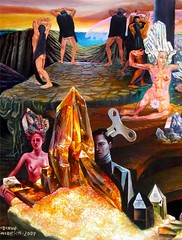
I've always been fascinated by the endless possibilities carried by light in a painting. For many years, the goal of my work related to the "light" as a subject in its myriad manifestations. I did this in many ways and forms. One of those ways was to explore and express the essence of gems and minerals. They have a fascination for me as a form of "solid light". I had a transcendental experience of seeing and feeling the essence of life under the reign of the lens. I saw the causal plane of their origin, including their filmmaker behind the matrix material. I was able to go in and out of their forms. It was so fantastic and I had only just begun to paint more "big" and then move slowly towards the expression of the essence of their "thin" experience. I also find it technically difficult to paint similar pictures.
For the mystic, the creation of images involves a symbolic way of expressing paradoxically the land beyond all names and forms, which include still other forms. This universe, this infinite space full of heavenly bodies and unimaginable forms, what was there before it? There was still "before existence"? How was it? It was something that could be seen? The land beyond all names and forms behind tutto ciò che esiste e fornisce tutte le possibilità di essere.
È come la tintinnante cavigliera di una divina danzatrice, che ballando graziosamente tesse l'invisibile dietro infiniti mondi. Contemplando una massa di luce indefinita si può ottenere solo un qualcosa d'intangibile, una lieve forma dell'informe del fausto corpo del Divino; uno degli infiniti modi per vedere questa luce viene spiegato nel modello d'irradiazione dei raggi. Tali modelli energetici, che compongono lo spirito della materia, eventualmente tessono i loro modi dall'intangibile alla tangibile tela; vestono il pensiero di un'arte dell'anima. Consolidati i modelli, condensati fuori dal Tutto, si crea un microcosmo di infiniti e più piccoli insiemi. In this way, art can also be seen as a holon aesthetic. A painting can evoke and to precipitate this process reflects the principles microcosmic macrocosmic and each individual image becomes smaller than a reflection of the broader All together, in which everything resides. The universe is constantly created, maintaining and destroying forms. Stars are born, give light and heat, they become nova and die. So this is constantly being created with the mind, keeping and destroying the forms of thought, reflecting the creative process of the universe. Likewise, the artist of the soul, a little of everything Everything's largest, begins a creative process, in itself, of disintegration, reconstruction and reintegration through the path of the soul towards the reunification of the Spirit.
5) The reason for the change is very frequent in Visionary. What does it mean to you? trasformartiva The vision is a reflection of the evolution of artistic consciousness of the individual and collective levels. It is often experienced when the mind is calm and identification with the 'ego' is temporarily suspended, as in the genuine state of meditation. The true visionary artists use their skills to come in and say something transpersonal state. Experience transpersonal meditation (and the painting is a form of meditation) or the state of consciousness of "not I" as in the creative process, although many people reach moments of not being, or "I" or are "lost in this "an experience in which all sense of identity at the moment is gone and there is the unified consciousness, and these experiences seem incomprehensible to those who have not had them. For modern conventional scientists, rational thinking creatures, and for the most part, still attached at the time of the Enlightenment, considered the mystical awakenings and non-ordinary states of consciousness as self-deception, charlatanism, chemical events in the brain, mental disorders, blunders, or the like. The non-conceptual thinking is often difficult to describe with words. Still, fire a description, or a subtle image of intuition, the artistic experiences, inspiration and indescribable feelings related to such phenomena as a complex mathematical exercise, to feel love or pain, visions of ecstatic experiences and find enlightenment spiritual. In fact, the state of "no self" and being "lost in the present" have been tried over the centuries and described as valid and powerful means of perceiving the whole of Reality. This unselfish play of consciousness in cui uno “perde se stesso” nello stato di “non Io”, è anche un terreno fertile per la creatività, il genio e la trasformazione.
L’artista estatico esclama, infatti, quello che tutti noi potremmo esclamare: “Io sono l’Assoluto, il sorriso e la tristezza, il leone e il passero.” Ognuno di noi può dire: “Io sono un fetido uomo senzatetto, tu fingi di non vedermi così come il prigioniero che hai giustiziato, il bellissimo bambino che ride e l’anziana donna che muore alla porta accanto.” Stiamo guardando fuori da ogni faccia; siamo stati scavati dalla stessa UNICA luce. L’esperienza estatica può essere una sorta d’intossicazione blessed, and at the same time a crystal created by the flash of a meteorite of a loving light timeless. It is a form of manic or disease of any kind. From them you were away, and remember that before this trip you knew everything. That you talked about yourself for yourself. Neither the time or space, or the birth or death was a condition. There was nothing else to try. It comes just a hint of memory, if you want a slight feeling that the eternal happiness seemed timeless and continually boring, or at least an impression of lacking creativity. You remember, yours is a vague memory, which creates an illusion that limits the range of your perception. Now, tu sia un pittore o un idraulico, tu guardi al di fuori del mondo delle forme, attraverso gli occhi estatici della mancanza di forme. Tu vedrai per sempre e poi vedrai te stesso come disgiunto: come un fiume, un cavallo, un montagna. O come tuo cugino, amico o padre. Tuttavia, vi è anche questa unità interiore, questa spinta verso la scoperta di se stessi che ritorna verso di te, alla memoria totale. Ti svegli e comprendi che stai intraprendendo un grande pellegrinaggio che ti porterà lì dove tu sei iniziato, verso chi e cosa tu sei sempre stato e sei ancora adesso, quello che sarai sempre e quello che stai diventando. Il motivo della trasformazione nelle opera dell’arte visionaria riflette ed esprime questo viaggio-non viaggio.
6) What is art to you visionary? For me, and many so-called "visionary artists" may disagree, the Visionary Art is a term that describes the work of artist-mystics, or even what I called "artists creaintuitivi" that combine their creativity with their intuition in their quest for a spiritual revelation. I also describes visionary art as a kind of art the Soul of God that leads to art like an artist marries Psyche with techno, so as to intercept the universal form and the sacred language. Art is a fluid language that speaks to us and sacred, not only with resonant comfort and serenity, but also with a powerful potential for transformation. It may be a flaming sword of change. Most of our authentic visionaries have simply visions. They are ecstatic nature. They were born having already passed through the primary image, and are fully involved in the Spiritual Imagination. They have experience of ordinary consciousness, auditory experiences, clairvoyant and sensitive ... and often without the aid of drugs or ingesting substances of any kind. Following the impulse and the forces of an innate creative nature, the mystical art passes through the membranes of consciousness. Using the tools of their art, the creative act events, like a mirror, reflecting the signs and symbols of the Spirit. The Spirit brings the practice of art to transcend our limited and frozen into a more expansive identity of ourselves and the infinite nature. Work produced increasingly reflected the language of the soul deeper and richer. The visual language is also acting as symbols and signs for creative author, responding also to his spiritual journey. The mind becomes a microcosmic reflection of macrocosmic principles in the process of the great universal creation. As I said, the stars, supernovas, planets, moons and cosmic material come and go, they are constantly created, nurtured and destroyed, and the same happens with the mind, always bringing new forms of thought and image in the making, building them, feeding them artificially and dissolving continuously-reflecting the Creative Process Universal until the Deity is perceived, and lived together without any clear-overshadowing the eyes of the soul. Significant
The reality of the image as a creative path can lead to the contemplation and to include both the dogma that the nature of illusion. Because we believe rare states of consciousness that evolve beyond the imagination, spirituality, whose description can not be made with precise language and appropriate, our task of increasing difficulty. The main feature of the imaginary spiritual is to work through its most significant capability and can be summarized as follows. One imagines that it can ascend above the multitude and the division of our general consciousness and rise above himself (his self-centered personality and limited identification), through the vehicle spiritual imagination. Here the consciousness of living in a sort of cloak and the illusion of separateness from the world around us fade. Thought, love and will become one, the feeling and perception that have been rationalized. In this case, at some level, their art becomes complete in their essential nature. The search for creative work, across the bridge that leads from the primary Spiritual Imagination runs parallel with the age-old question and the search for ultimate truth that lies hidden beneath all the partial truth, in all the polar opposites that affect human perception, a search that does not end in vain. We need not be content with partial truths revealed by astronomy, archeology, biology, history, all truth put each in its own field, which sometimes contradict or appear to contradict one another, not complete in same, not showing us the full picture, and the same with the truths of mathematics e della fisica, o quelle del linguaggio, verità primarie che obbediscono alla regole che gli uomini stessi hanno creato. Al di là di tutte queste, al di là delle contraddizioni di ciascuna verità separata, si trova nascosta la suprema, finale e intera Verità, la sintesi finale, che l'umanità ha cercato di trovare e non è mai riuscita a integrare armoniosamente. L'arte può assumere una profonda qualità non etica e può portare una nuova conoscenza e intuizione, quando muove al di là della fantasia e rivela luoghi interiori che non potrebbero essere conosciuti in altri modi. Questa conoscenza è acquisita non attraverso l'osservazione, ma attraverso la partecipazione e fusione tra lo spirito e la materia. Colui Imagine that, the subject is no longer at the screen of vision, the object and the two come together and merge. In the realm of the imagination, even when it is built comes as mentally or inspired vision, this is still a kind of object, even if done on the order of thought, or dell'etereo substance of an inner vision. This occurs, initially, as something other than ourselves, immediately followed by the experience of the merger, where the knower and the thing known become one. One can imagine that participation in the divine, and some of them do. The artist is conscious of being what he knows and what he knows is himself.
C’è un’arte visionaria “integrale” e un’arte visionaria “parziale”, un po’ deformata, o una distorta impressione ed espressione di un altro stato della coscienza. Il Surrealismo, per esempio, poteva essere potente, caricato emozionalmente, ma pur sempre qualcosa di “parziale” o addirittura deformato. Esistono “artisti visionari” che vivono stati alterati ed esprimono queste esperienze, ma spesso ciò risulta freddo, privo di sentimento umano, sono artificiali e mancanti, soprattutto se sono “fantastici” e rendono con realismo fotografico che ci lascia solo con un brusco colpo del Cosmico, ma non irradiano nulla del livello emozionale. Definisco "Bad art" only what it lacks feeling. An integral visionary art, as well as a healthy spirituality, is free from addictions and prohibitions and is characterized by an openness and willingness to face reality. An art full expression of our humanity, diversity and divinity, of our fragility and strength, our darkness and our light. Expressing respect for life and enhances our capacity for love, peace and joy. Influence his experience in the inner worlds than in the outer and implications through personal, social and cultural rights, its impact is inspiring and fusion experience. Powerful art can be equally found among those artists who have made as a lifestyle choice than the traditional religious life, and among them there are those who do not think at all to religion, maybe even atheists. The fruits of both are equally tasty and you can feel their work of art as opposed to its appearance, because art can work within us, in our laws of becoming, in the marrow of our bones and authentic soul.
In art full, a genuine aspiration, such as in spirituality, requires certain qualities, including the awareness of a transcendental dimension, a sense of wonder, love and gratitude, compassion and kindness, the desire to connect to the Absolute, the supreme essence of Living Light. This integrated spirituality supports the freedom, autonomy, self-esteem and social responsibility. Do not deny our humanity, nor depends on the suppression or denial of emotions, sexuality, beliefs or whatever. It is inclusive, not exclusive. In contrast, encourages the heart to feel and to trust in the wisdom of intuition, includes, in fact involves the soul, mind, life and body together, which is the final expression in art and in our interaction with the life, through all these means and containers. The characteristics of an art full of spirituality and are those of psychological maturity. Succumb to the impulse is personal growth to all creative industries is a fundamental impulse that unifies the look and consciousness. Many doubt that a creative perspective with an atheist may have never experienced the finer stages of consciousness and vision, as if a rule of exclusivity would exclude the 'inclusiveness, and openness required to live as what the mystics were thin describe as a "union with the divine." Not at all, I am not convinced that such experiences are not possible for an "atheist", although only a catalyst to transform our system of beliefs. All our motivational drives are subject to the fundamental thrust of achieving spiritual unity with the Absolute, consciously or unconsciously. Each subsequent stage of the psycho-spiritual development requires a higher order of unity. At each stage I will look for our unity in accordance with the constraints of a particular self-concept with the quality of identification. The reward in each stage is also an illusion that prevents the release if we mistake it for the end of the path. With clarity and consistency, as in a hyper-advanced process of expanding the premise of slow but the cumulative effect of "peak experiences". In the writings of Wilber experience that is woven daily human spiritual growth and not in the occasional and rare events described in the thesis but slow, or as in an epiphany of self-realization and life. The practice of art can afford to continually experience these peaks and these were placed in the interior, where they weave the fabric of transpersonal practice that inevitably leads to the progressive states of consciousness and a growing connection with the Cosmos itself. So I can also see the Visionary Art as a manual work within a wider spiritual practice.
7) When I read your biography, I noticed that you have carried out several projects in schools d'arte e centri di collaborazione tra menti creative. Qual è, oggi, la loro funzione? Tutti i miei progetti culmineranno, presto, in un luogo che io chiamo "Villa Visionaria", che ho progettato di stabilire in Italia. Questo dovrà essere un posto di ritiro artistico, di studio e di produzione creative. Vi risiederà un piccolo numero di spiriti congiunti, vivendo come una comunità creative. Per una parte dell’anno sarà anche aperto al pubblico come galleria, accademia o forum per progetti d’arte collaborativi con la comunità, in generale, sull’educazione, l’industria le arti e le scienze. In particolare servirà da impegno consolidato di tutti i miei efforts and events of the past, transcending but including everything that came before.
8) enables collaboration between artists who are not afflicted by conflict and rivalry? artists need to gain new perspectives in the collaboration, as opposed to their outdated views, as demonstrated by one of my colleagues wrote: "... the artists are, at best, friendly enemies." Jealousy, the resentment and wheezing rivalry must end, and must begin a new method of cooperation. The key word here is creative community of cooperation. When we speak of painters, sculptors, composers and writers, who are artists who have not performed, it is obvious that their work as a life requires something a bit 'of seclusion, which can color the personality and induce a form of autonomy and a life of isolation. In light of this, an effort should be made to add the contact with the world in general, to cultivate and maintain a balance of emotional and psychological. Even for the artist "spiritual" is unnatural and contradictory, something inhuman, allow prayer, meditation or the practice of art create a sort of spiritual isolation. " When the artistic practice, prayer and meditation become an elixir for the isolation, when it consists almost entirely in a beautiful and blissful contemplation of the heavenly gods, it loses much of its influence socializing, its full essence of love (to embrace, receive, give), and tends to isolate those who practice and deprive the world of another positive force. There is a certain danger and loss of human integrity, both personal and collective, through prayer, meditation, and the only private establishment, everything is in balance with the company of others, depending on your "company", but it is also a matter of choice and selection. It is now important for artists to go anywhere towards integration and the contribution of creative, do their own creative ability and power to the mainstream. It is equally important that the community in general and undertakes interacts with the world of artists. The world desperately needs this infusion and full report. All factors of insulating creative visionary type are not entirely within its jurisdiction, much of this separation is due to become a visionary driven out in fringe communities. Genuinely creative opportunities made available by the political forces and communities are rare, if it were possible, they are almost always oriented toward the conventional, commercially artistically acceptable and "appropriate" in order to represent their belief system at the base of the community. So the integration must be a duplication of effort, as the art direction is a transpersonal practice that involves the cultivation of awareness of the presence of God, which is entirely laudable, but when these practices and experiences lead to social isolation or culminating in the fanaticism religious, intellectual and exclusivity into attitude, all things reprehensible. Artists must guard against such misconduct. Because of the oppressive nature of the artistic journey and the challenges of this world, regardless of the mystical creative world can hide in a banal existence enclosure, or polarized charm, protecting himself, in a kind of armor, from the comforts of fame, the glitz, the glitter and glory, through a select circle of admirers chosen. I think this is very important, therefore, for the mystic throw a creative eye, from its isolation, to these trends, both in poverty, in pomp and glory. Work against this trend. organizing workshops for painting, through a genuine "creative community" and circles of education and inspiration, readings and meetings with the public, writing books for the public, and organizing various events that unite artists with the public.
Such new visione del mondo. Sono richiesta una prospettiva mondo-centrica, anche teo-centrica e un’arte integrale. Il modella dell’artista scorbutico, isolato e individua è adesso inattuabile, è essenziale un approccio più collaborativi tra l’artista e la comunità, e può essere avviato. Gli artisti contemporanei che hanno colmato e riconciliato la loro esperienza interiore con il mondo esterno attraverso la pratica spirituale, hanno adesso collocato se stessi come potenziale “punti d’ispirazione” per lo sviluppo della comunità creativa e quindi per la più Grande Tribù, sebbene si potrebbe anche essere sorpresi di scoprire come esistano pochi di questi artisti che pratichino sinceramente quello che predicano and paint, even if in the midst of the hordes of creative people who are labeled "visionaries" or servants of the Spirit. The mystic creative, having married inner psyche (soul), the realm of mind / spirit, with the world of matter, and techne (body / technique), is competent in a role that allows you to drive himself to show activities and actions responsibly creative. The highest task of the artist is inspired, rather than making their own decisions, or making art purely negative, negative to comment on events and conditions, without any kind of positive vision, or the replacement proposal of creative solutions, or healing action , or other aesthetic possibilities of advanced awareness to something else. The unveiling of a policy or a wrong world, through art, certainly indicates a noble use of skill, but it would be more comprehensive by offering a creative solution, albeit a form of expression of some higher ideal , a creative solution or a vision. Certainly there is room in all our art museums, including an integral art that, although we have rarely seen. I'm not talking about replacing the usual objects of modern art, but to include what is intentionally left out. Through a resumption of cooperative relationship between the community and the creative function of the artist-planner e dell’ ”artista politico” dalla mente integrale può acquisire un ruolo più positivo e costruttivo. Nuovi approcci verso e per la comunità possono permettere un lavoro innovativo, che emerge non controllato da limitazioni autoimposte da una comunità non familiare che dirige l’esperienza creativa, l’espressione di stati non ordinari e il potere di una visione e di un’arte trascendenti. Visto che le comunità del nostro tempo negano il talento artistico accoppiato a una visione spirituale, esse dovrebbero essere incorporate e accompagnate da questi creativi agenti di trasformazione.
Gli artisti che si sviluppano guardando al di là del loro tradizionale ruolo, in quanto non solo creatori di forms and "rugged individualists", accept responsibility for the creative direction of their fellow creative and total community. Moreover, artists reluctant to support their fellow creatives are simply surrounded by fear and insecurity. Remain in a state of being selfish and competitive early isolates them, undermining their personality and well-being. Through the subsequent understanding of an active integral art, the artist becomes aware of his inner life can be understood in the wider life outside of the community, responding to the needs of both individual and collective ones, really emerge as an artist in full, otherwise Dov 'is humanity in being a "visionary"? The result would be the visionary artists eager to do the museums themselves, honoring only themselves, not unlike a Pharaoh. The artists who take real responsibility for their actions and through their growing visibility, communities take responsibility by the artists integrated into exile rather than the rule of outsiders. An artist who aspires to become full is more likely to achieve what the artists integrated into the community have achieved before him. We can accuse the artists of this nature anti-social and unbalanced in a culture that rarely integrates, appreciate or know their potential, primarily practical and artistic visionaries?
I'm still seeing what this new role should be symbolic for the artists and the community. Villa Visionary explore this. The intention of community participation will vary depending on the form of art, but this new report artistic, social, political and spiritual must have universal implications. In this stage should enhance and reveal archetypal experiences. Its development in the community is to allow people to contribute to the design, architecture, and progress in the life of their own community, education, cultural activities, business and, ultimately, to their lifestyle, which should be sensitized and expanded through the creative process of participation. This is a way for people to become spiritually free, and freedom always includes creativity, and creativity always involves responsibility, and this raises the collective consciousness through authentic learning experiences with real life. This includes what happens to us and what will happen. Instead, in our present situation we have a political subservience to a corporate technocracy bent to suckle her nipple with people who have creative but his courage, through moments of political education industrializzante ed'indottrinamento. And we have a società che è divenuta compiacente, che si accontenta di succhiare questo latte artificiale, anche se a volte vengono alimentati con del latte avvelenato; le menzogne, i rigidi schemi mentali, il mercato, l’ordine del giorno politicamente corretto che invece è scorretto, i piani militari ed economici, gli innaturali sentimenti di nazionalismo legati con contorte radici alla propaganda basata sulla paura. Sto parlando di un ritorno alla libertà creativa e alla responsabilità dell’individuo e della comunità come appartenenti integrati.
9) Com'è stata la tua esperienza artistica con Ernst Fuchs? La tua domanda mi ricorda le più meaningful words I heard from my mentor, Ernst Fuchs, who said, "the artist is called exactly like a prophet."
More important than the knowledge of the old masters who have shared with me, was to instill an attitude that art is noble, in fact, because it is a noble service to the divine. Like any American boy of 19-20 years in Vienna, to study with the great masters had been one of the most magical and mystical periods of my life. That time is always an honor for me and richness. Ernst was my father and reinforced my artistic creativity with the mystical, and shared his knowledge of the old masters with me. He has given me an honorable and fed the flame of artistic perception as sacred and mystical practice. This experience was priceless and magical.
Now, my esteemed mentor is a Christian mystic in her practice and art, and I respect his beliefs. However I can not ignore the fact that all my studies and my spiritual pursuits have led me to the conclusion that all paths contain some partial truth. In the pursuit of philosophy and art, research in the condition of lighting, you should exercise special intelligence released in which the human mind and spirit feel free to go up. Not restricted by limitations of time and especially, the art does not recognize laws except those that govern its reasoning or created reality. This activity disinterested, in which the research explores the workings of the mind freely, is a huge asset. Opens the doors of inspiration, and is in the midst of the greatest experiences that a person can earn and enjoy. This is the work of modern art and mysticism may be associated with the active cooperation and cultural institutions. The noble art is a skill, the progeny of mortal dll'uomo mental material, inspired by an outer frame that takes the fabric on which the small "I" weaves the model of character with the supreme universal self, the great "I", its value is enduring and spiritual expression.
artists serve as the eyes of the soul. To the extent that the evolution becomes imbued with truth, beauty and goodness as the realizable value of an enlightened conscience, and that goes for everyone, not just for artists, this can be a force of indestructible love. I do not think that the artist is a special kind of person, but that every person is a special kind of artist, and all are subject to the same spiritual tasks. If a soul does not seek eternal values \u200b\u200band love, then there is death without meaning and life itself becomes an inevitable and tragic illusion. Lately I think my old mentor and friend would agree with me that all artists should work only for love and service of One, which illuminates the mystery of enlightenment. A famous aphorism of philosopher Herbert Spencer is a wonderful definition of our association to divinity:
"God is infinite intelligence, infinitely diversified through infinite time and infinite space, manifesting through an infinity of individuality that will always evolve ".
10) Have you visited and taught in Italy. What do you think of our cultural context? Of all the places I visited on earth, Italy is the one I love most and the last place I'd like to call "home."
Benedetto Croce, is one that outlined the role of intuition in art and inspiration in its very deep philosophical teachings. Croce, an Italian philosopher of the early twentieth century, is the founder architect of the modern system of art education in Italy, is still in force in all universities of this nation. The art student in Italy must also, at present, is also studying the philosophy the arts, because he saw that these two cross paths were like two sides of same coin. His philosophical approach to art is the inspiration to pass on what art is and what is not, citing the realm of feeling such as peak and leads to the intuitive expression, otherwise the pupil Vedantic saying: " neti-neti, not this - not that! This Western philosophy, namely the Cross, sees aesthetics as a general language, because his study covers all media, all forms of symbolic construction, the paradigm of what is a universal language of art. The position of the cross contains a clear doctrine and his "circle of spiritual" is, in my opinion, an accurate description for the start of an 'Integral Art. " In his analysis of intuition, Cross identifies with the spirit of artistic expression and argues that the external intuition is secondary to its appearance to consciousness of the artist. It is in this land that the expression is significant beyond its embodiment or projection in a work of art. With this result, art has become "a symbol of feelings", Nature, the soul and God
I find Italy a place where they are more inspired. Its rich history, its countless masterpieces, architecture, people and landscapes are valuable resources for the world. I love it. In the summer of 2008 I returned to Italy to teach, this time to Papiano, in the province of Perugia.


website:
http://www.rubinovs-lightning.com myspace:
http://www.myspace.com/oldmastersnewvisions (Sabrina Abeni)